
Version 2.3.1 — AskOn3 Reporting — Released January 30, 2026
This release introduces AskOn3 Reporting, giving Business Unit Admins and leadership teams an aggregated, organization-level view into how knowledge is being used—and where gaps may be driving cost, risk, or rework.
Highlights
-
AskOn3 Reporting (New)
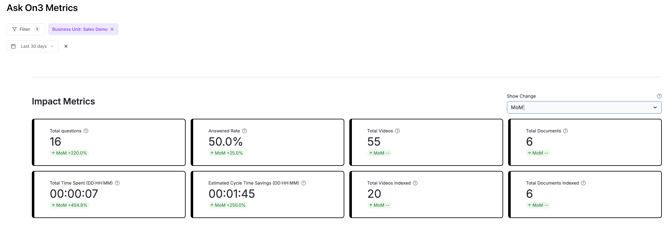
Workspace and Business Unit Admins can now access a centralized AskOn3 Metrics dashboard that rolls up usage and performance data across all workspaces, without switching contexts.
-
Identify Knowledge Gaps That Drive Cost & Warranty Risk
Aggregated reporting highlights:-
Topics generating the highest volume of unanswered questions
-
Knowledge areas with repeated questions and lower answer confidence
These insights help teams proactively address gaps that can lead to installation errors, inconsistent execution, and warranty callbacks.
-
-
Measure Overall Answer Effectiveness
Track overall answer rate vs. unanswered rate across the organization to understand how reliably AskOn3 is resolving field questions and where additional training coverage is needed. -
Track Adoption & Engagement at an Aggregate Level
See how AskOn3 is being used over time through:-
Active user counts
-
Total questions and conversations
-
Aggregate time spent engaging with knowledge
This validates adoption trends and ensures AskOn3 is supporting teams in real operating conditions.
-
-
Understand Which Content Reduces Rework
Reporting surfaces:-
Content most frequently referenced in AskOn3 answers
-
Topics that consistently support question resolution
This helps organizations invest in content that prevents mistakes and improves consistency, rather than producing content that goes unused.
-
-
Quantify Time & Cycle-Time Savings
Estimated cycle-time savings provide a high-level view into how faster access to accurate information helps reduce delays, repeated work, and unnecessary escalations. -
Filter, Compare & Export for Leadership Review
Metrics can be filtered by Business Unit, workspace, and time period, and reports can be downloaded to support operational reviews and executive decision-making.
Why This Matters
AskOn3 Reporting shifts knowledge management from reactive to proactive. By analyzing aggregate usage patterns, teams can close knowledge gaps before they turn into defects, delays, or warranty issues, and continuously strengthen the content that matters most—based on real usage, not assumptions.